User Personas
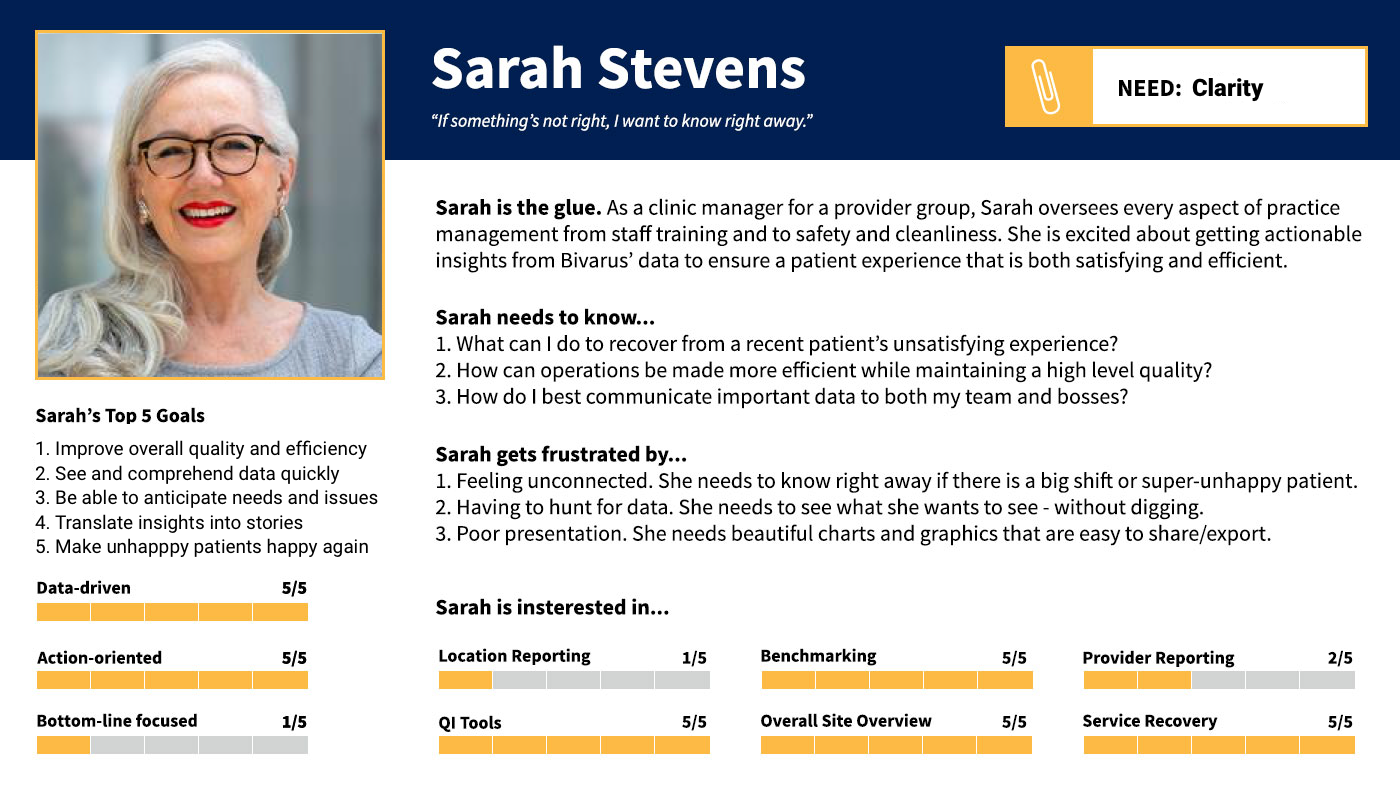
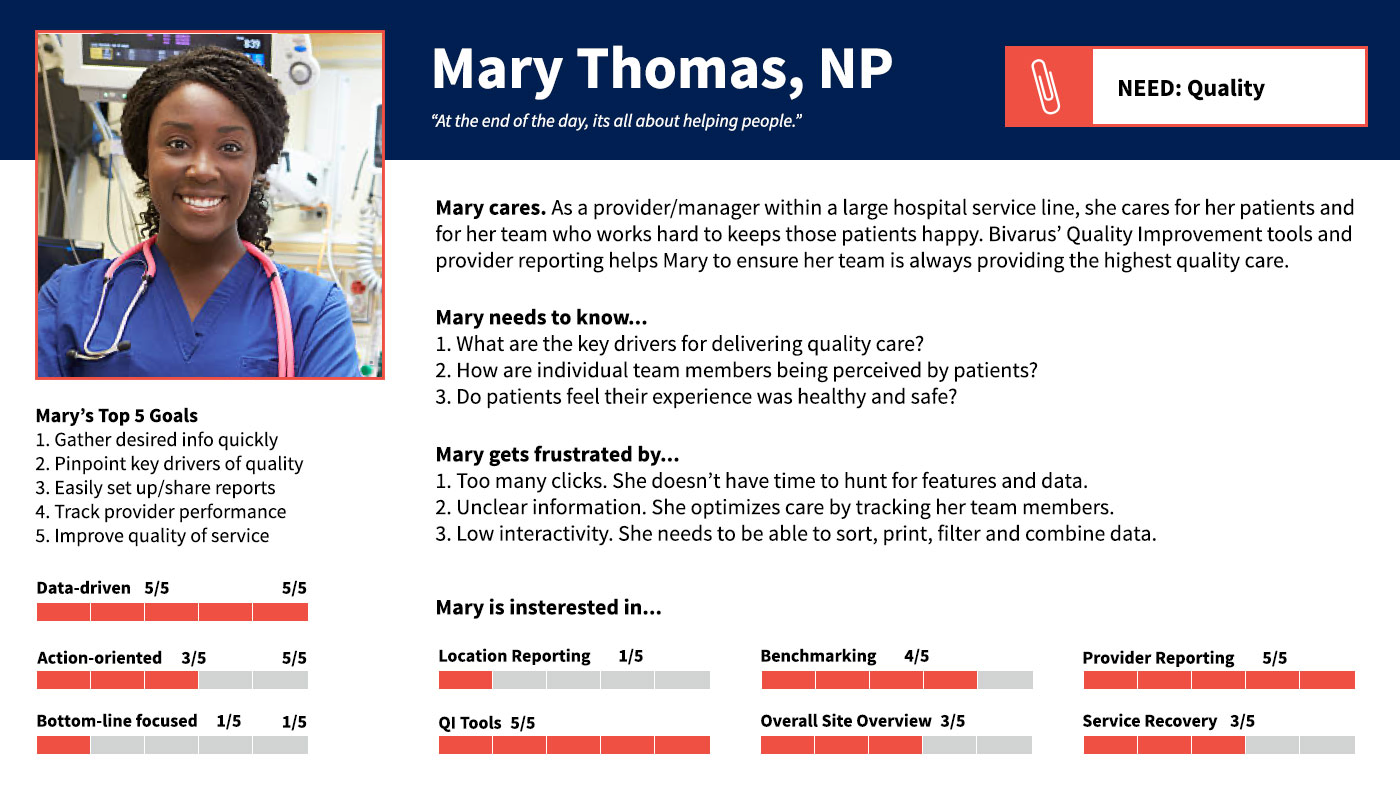
User Personas boost empathy by putting a human face on a set of common user needs, goals, and frustrations.
The CTO at Bivarus asked me to provide a user-centric perspective for a 2.0 evolution of their patient survey platform (which ended up being sold to their top competitor at 10x valuation!).
Because we were in the 'Define' stage, I decided to create UX Personas to help identify key user groups and provide focus around the specific problems to be solved to help the team focus during execution.
Through mixed method research (SME interviews, an online survey, data analysis), I was able to create and share a clear, confident picture of user needs for Bivarus 2.0.
My Role
🕵 UX Lead
Timeframe
🕒 4 weeks
Methods
- Survey
- 1:1 Interview
- Data Analysis
- Heatmap Analysis
Tools
- In-person Interview
- Microsoft Forms
- Google Analytics
- HotJar
- PowerPoint
Methodology & Process
① Data Analysis
When in new territory, I like to get the lay of the land by finding whatever existing research or data is availble
I immediately began scouring the platform's Google Analytics behavior flows and PULSE metrics (Pageviews, Uptime,Latency, Seven-day active users and Earnings).
I also implemented HotJar on the platform to get CES and NPS as well as heatmaps for analysis.
② Survey
Armed with some basic knoweldge of platform metrics and usage data, I shared what I found with the Project Manager and a draft of survey questions that would help us dig deeper.
Using MS Forms, a survey (CES, NPS, CSAT, multiple-choice, open text) was created and sent to current platform users.
The survey doubled as a screener for our interviews.
③ User Interviews
Based on survey data, I selected a diverse group of individuals that varied in role, sentiment and goals on the platform.
I met 6 interviewees locally and remotely to discuss their experience with the current platform and learn expectations for 2.0.
I worked closely with the Project Manager to ensure the discussion guide would yeild actionable insights. They also took notes during the discussions.
Outcome
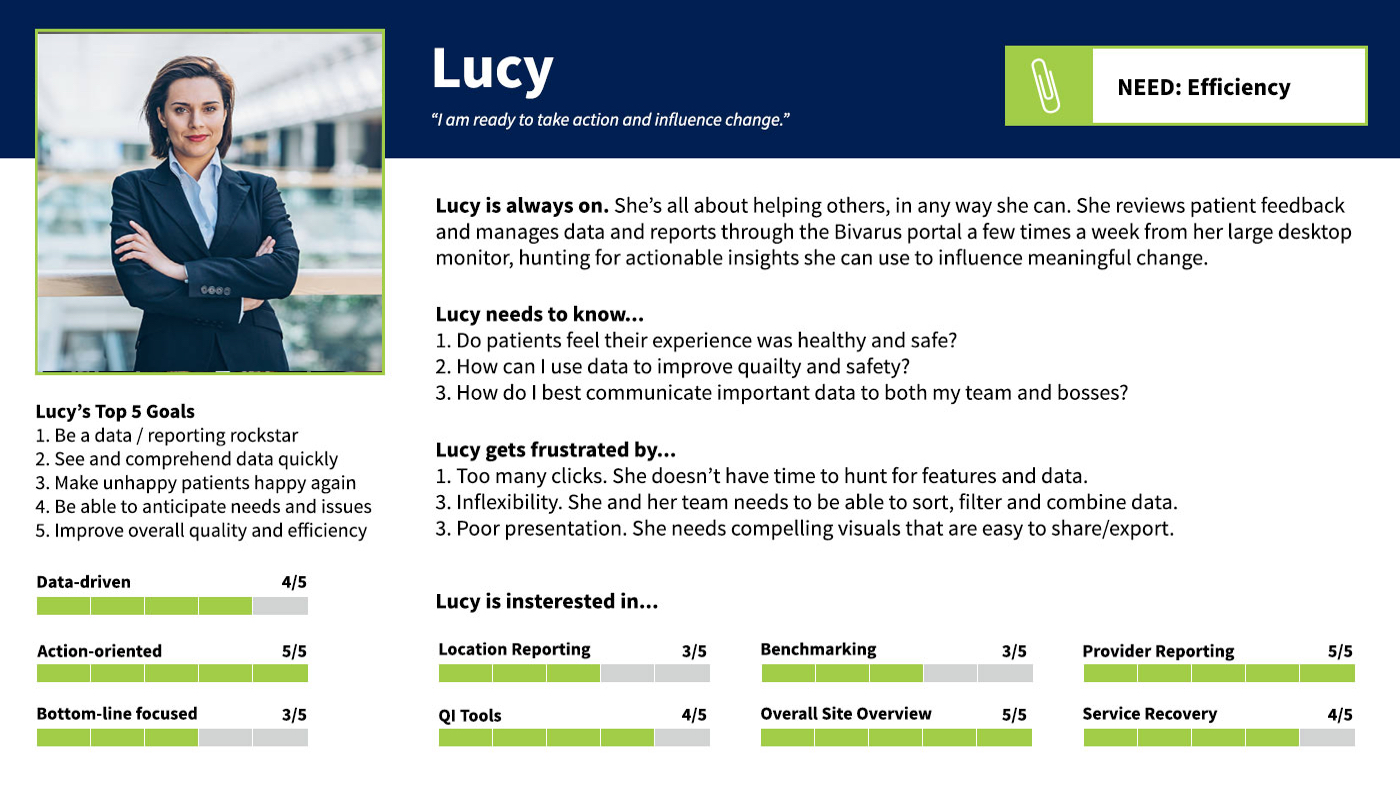
Our primary persona, Lucy became a focal point during PM-led roadmapping and feature prioritization with leadership, project management, and engineering. I then used insights generated during persona creation to build wireframe designs for the engineers to code.
Lucy was our primary persona, representing someone who was best positioned within their org to adopt our platform. She was the amalgamation of two other proto-personas which turned out more similar than expected.
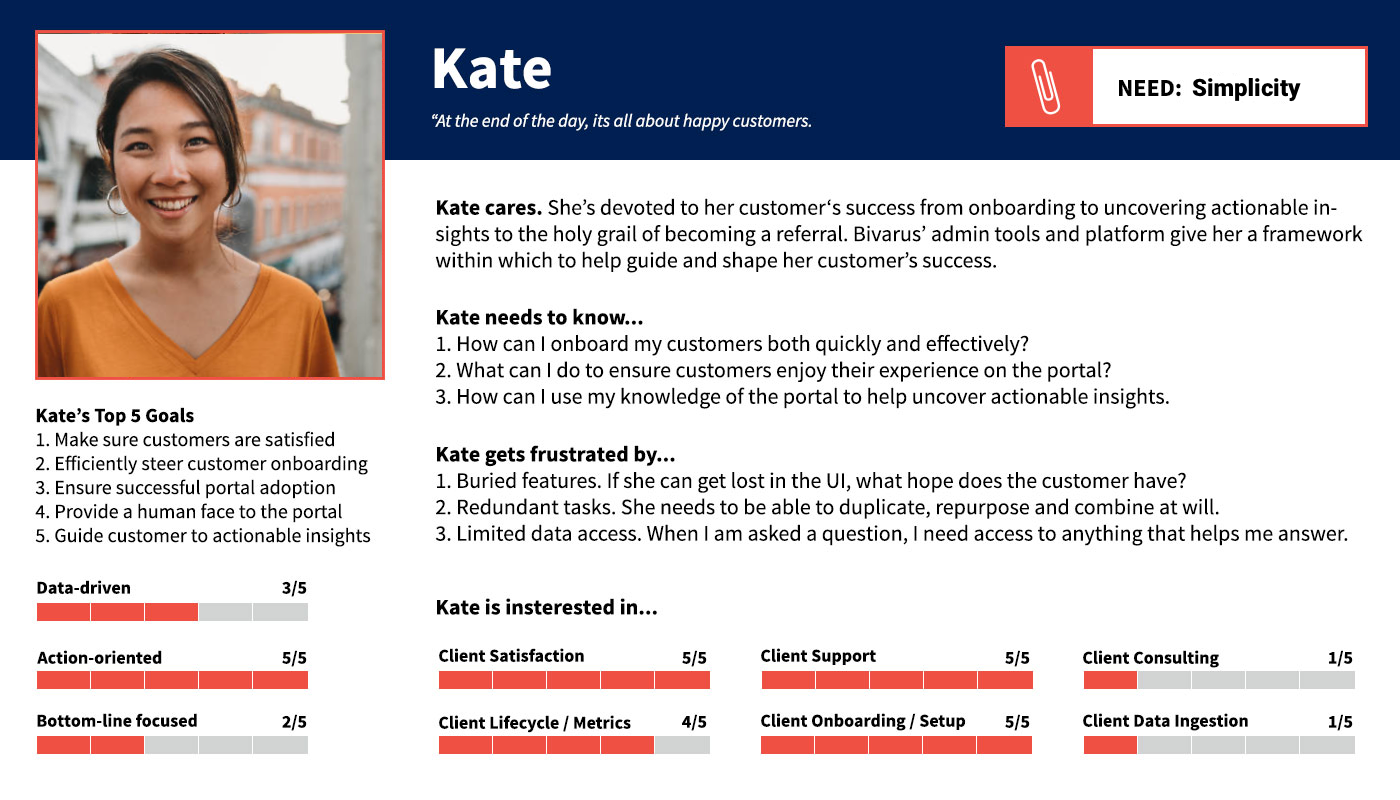
Kate was our secondary persona, meant to represent our internal employees at Bivarus who would onboard Lucy and whose hard work would make adoption fun and more successful.
To further adoption with the team, we pinned the personas up in several key locations within the office for quick reference and used them to write user stories for Agile/SCRUM implementation.
Sarah and Mary were early personas, representing key demographics. This is a classic example of how different jobs titles don't necessarily mean there will be distinct user needs. We agreed to combine them into Lucy for simplicity's sake and to help the team focus on a primary persona.